Deep water was harder than planned
Moving farms into deeper water needs anchors of three tonnes or more. No boat in Lamu could place them, so a deep-water farm at scale could not be tested.
Our story
For years, seaweed support on this coast meant training and little else. AFSFF began when we admitted that skills without money leave farmers where they started.
How we got here
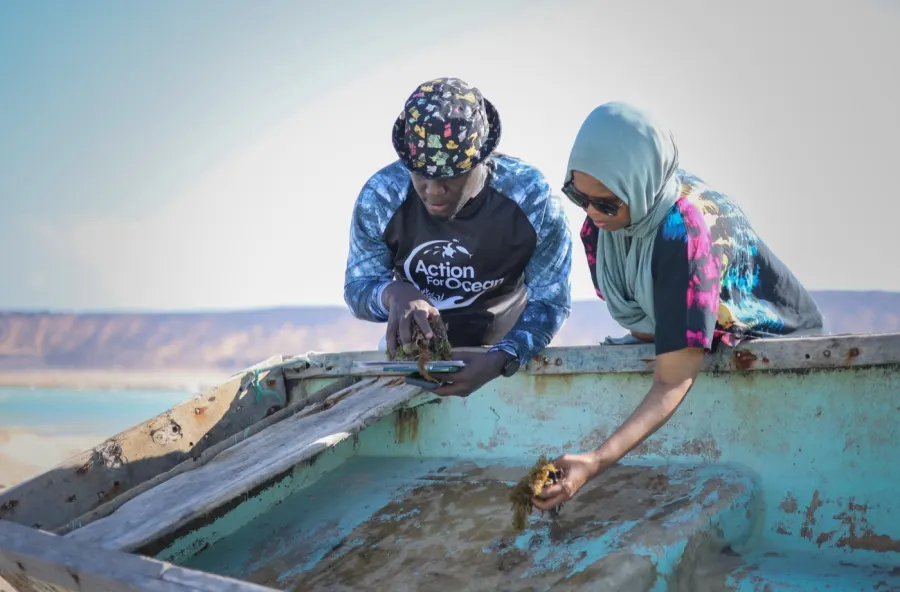
Action For Ocean worked with women seaweed farmers on product quality and market access. In 2021 we signed a grant agreement with SeaPower for work on gender and seaweed.
Farmers tried better tools, savings and small loans. A microcredit agreement with Sea PoWer followed in September 2023.
Our design proposal for the facility said it plainly: programmes for women seaweed farmers focused on training and technical help, and left the shortage of money untouched.
Field teams visited 20 villages across Tanga, Kilwa, Lindi and Mtwara. Farmers described traditional methods, unreliable buyers, climate damage and groups with no formal status.
With support from ORRAA, Action For Ocean began work in Tanzania and Mawimbi Ocean Innovations in Kenya. The 2023 design had put Kenya first; in practice Tanzania moved faster.
Security problems on Pate Island led Mawimbi to switch to an outgrower-only model. A July scoping mission looked at how the approach could work in Mozambique.
Savings groups in Mkinga District and Tanga City were running, and some had moved into formal bank accounts with NMB. The partners reshaped AFSFF into a facility that finances local, country-run facilities.
What we learned
Moving farms into deeper water needs anchors of three tonnes or more. No boat in Lamu could place them, so a deep-water farm at scale could not be tested.
When world prices for dried seaweed fell, Mawimbi turned to higher-value products and won approval in Kenya for two seaweed-based plant treatments.
A single central facility proved slow to adapt to each country's rules. Country facilities run by local partners now sit at the centre of the design.
The partners
Action For Ocean runs savings groups, training and field support in Tanzania. Mawimbi Ocean Innovations leads farming technology, buyer links and processing in Kenya. ORRAA funded the first project phase, from September 2024 to March 2026.
Partners and supporters
 Action For Ocean
 Mawimbi Ocean Innovations
 ORRAA
 SDG Impact Finance Initiative
 Convergence
 Flotilla Foundation
 DOEN Foundation
 Whole Planet, a project of Whole Foods Market Foundation
 Swiss Re Foundation
 Seaweed Café
Working alongside local government and village leaders in Mkinga and Tanga.